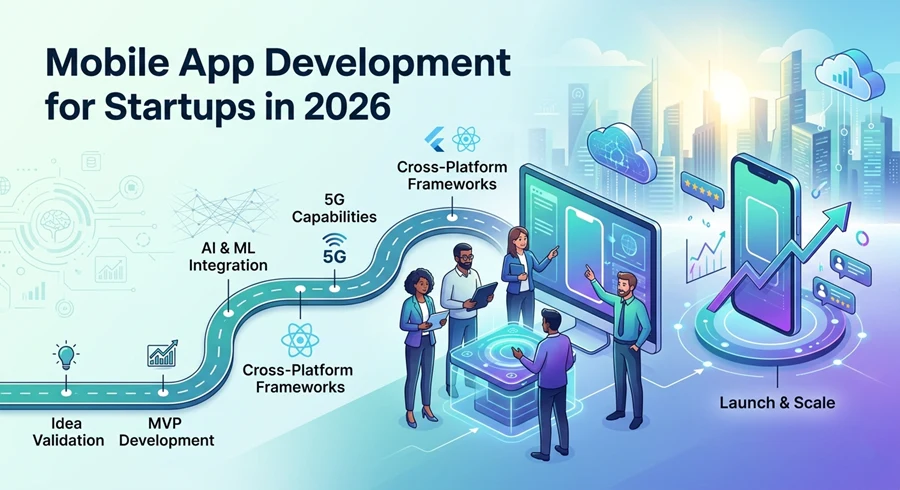
Mobile App Development for Startups: A 2026 Complete Guide
Global smartphone penetration recently surpassed 7.21 billion users, representing nearly 85% of the world's population. Startups operate in an environment where mobile applications act as the primary engine for customer acquisition, engagement, and revenue generation. The global mobile application market size is projected to reach $626.39 billion by 2030, presenting massive opportunities for founders and engineering teams. Building a successful application requires rigorous technical planning, precise execution, and a deep understanding of user behaviour.
This comprehensive guide outlines the entire development lifecycle, from initial concept validation through architectural design, technology selection, and final deployment. Software developers and technical founders will learn how to structure a Minimum Viable Product (MVP), mitigate common engineering risks, and integrate emerging technologies to secure a competitive advantage.
By applying the principles below, IT professionals can avoid common pitfalls and build applications that are robust, scalable, and meet market demands. You will discover practical methods for selecting the right technology stack, implementing secure backend architectures, and launching a product that resonates with target users.

Validating the Idea and Defining the Architecture
Up to 90% of startups fail. The most common reason, cited in 42% of cases, is building a product nobody wants. Engineering teams often rush into coding without verifying the core market need. Idea validation involves testing the app concept using surveys, landing pages, and simple prototypes to gather feedback before committing significant technical resources.
A surprising 23% of organizations admit they lack a clear market research strategy. Operating on assumptions often leads to bloated feature sets and wasted development cycles. Creating detailed user personas and conducting competitor analysis helps development teams understand specific pain points. Companies utilizing competitive intelligence report 15% higher revenue growth rates on average.
Once the market need is confirmed, technical leaders must design the application's high-level architecture. This blueprint dictates how client-side components interact with server-side databases and APIs. Startups must decide between a monolithic architecture and a microservices-based approach. Monoliths offer simplicity during early development stages but become difficult to scale as the user base grows.
An estimated 77% of organizations have adopted microservices to build flexible and robust systems. Microservices allow independent teams to deploy, update, and scale specific application functions without disrupting the entire platform. This architectural choice heavily influences future technical debt and overall system reliability.
Selecting the Right Technology Stack
Choosing a technology stack is a critical decision that impacts development speed, application performance, and long-term maintenance costs. The stack comprises the programming languages, frameworks, databases, and third-party tools required to run the application.
Native Application Development
Native apps are built specifically for a single operating system. Developers use Swift or Objective-C for iOS, and Kotlin or Java for Android. Native development offers superior performance, robust security, and direct access to device hardware like GPS, cameras, and biometric sensors.
Android currently holds roughly 72% of the global smartphone market, making it an essential platform for international reach. Building native applications requires maintaining two separate codebases if targeting both major operating systems. This approach demands a larger engineering team and a higher initial budget but provides the smoothest possible user experience.
Cross-Platform Frameworks
Cross-platform development allows engineers to write a single codebase that deploys to both iOS and Android. Frameworks like React Native and Flutter have gained massive popularity among startups due to their efficiency.
React Native utilizes JavaScript and bridges the gap between web and mobile interfaces. Flutter, developed by Google, uses the Dart programming language and its own rendering engine to deliver near-native performance. Cross-platform tools significantly reduce development time and lower costs. They do occasionally face performance bottlenecks when handling complex, high-refresh-rate animations or highly specific hardware integrations.
Low-Code and No-Code Platforms
The software development landscape is rapidly shifting toward visual development environments. Analysts predict that by 2025, 70% of new applications will utilize low-code or no-code platforms. These tools allow rapid prototyping and MVP creation without writing traditional code. Platforms that integrate artificial intelligence can generate production-grade applications rapidly, allowing technical teams to focus on custom backend logic and complex API integrations rather than on basic interface construction.

UI and UX Design Principles
User Interface (UI) and User Experience (UX) design determine how intuitively a user interacts with the application software. Excellent design translates directly into financial success. Research shows that every $1 invested in UX design can yield a return of up to $100.
Wireframing and prototyping are essential steps to visualize the application layout before backend integration begins. A wireframe serves as a structural sketch of the app, while a prototype functions as an interactive model. Fixing a usability issue during the prototyping phase is up to 100 times cheaper than addressing it after writing the core code. Engineering teams must collaborate closely with designers to ensure the proposed interfaces are technically feasible within the chosen framework.
MVP Development and Security Protocols
The Minimum Viable Product methodology focuses on launching a version of the application containing only the absolute essential features. This strategy allows startups to enter the market quickly, test their riskiest assumptions, and gather real-world usage data.
Agile Methodologies
Agile development methodologies emphasize iterative progress, continuous feedback, and flexible planning. Currently, 71% of software companies utilize Agile practices. Breaking the development cycle into two-week sprints allows teams to release functional components rapidly. This iterative approach prevents developers from spending months building features that users ultimately ignore. Industry data indicates that between 64% and 80% of software features are rarely or never used. Focusing strictly on core functionalities prevents resource drain.
Implementing Robust Security
Security and data privacy are non-negotiable requirements. A single vulnerability can destroy a startup's reputation. The average cost of a data breach reached $4.24 million in 2021. Developers must implement secure authentication flows, such as Single Sign-On (SSO) using OAuth2 with PKCE.
Regulatory compliance requires adherence to laws like the General Data Protection Regulation (GDPR) in Europe and the California Consumer Privacy Act (CCPA). Failing to secure personal data can result in massive fines, sometimes reaching up to 4% of a company's global annual turnover. Engineering teams should practice secure coding, utilize data encryption at rest and in transit, and conduct regular penetration testing.
Go-to-Market Strategy and App Store Optimization
Technical completion does not guarantee market visibility. A structured launch strategy ensures the application reaches its intended audience effectively.
App Store Submission and Optimization
Publishing an app requires setting up developer accounts with Apple and Google. Apple's review process is notoriously strict, with reports indicating that approximately 40% of initial submissions face rejection for guideline violations.
App Store Optimization (ASO) functions similarly to Search Engine Optimization for mobile platforms. Approximately 65% of all downloads originate directly from searches within the app stores. Developers must optimize the app title, description, keywords, and promotional screenshots to rank highly for relevant search queries.
Post-Launch Analytics
Implementing robust analytics tools allows technical teams to track user behaviour accurately. Routing event data via tools like Google Tag Manager or Mixpanel helps identify where users drop off during the onboarding process. Companies making data-driven decisions are often 5% to 6% more productive and profitable. Continuous iteration based on this analytical data forms the foundation of long-term application retention and growth.
Cost Estimation and Timeline Planning
Accurate budgeting and timeline forecasting remain persistent challenges in software engineering. A comprehensive McKinsey study found that large IT projects run 45% over budget on average, while only 31% of projects come within 10% of their original financial projections.
A simple MVP typically costs between $10,000 and $50,000 to develop, requiring two to four months of engineering effort. Complex applications featuring custom machine learning models, real-time video processing, or intricate backend microservices can require budgets exceeding hundreds of thousands of dollars and timelines extending past a year. Startups must build buffer time into their development schedules to account for unexpected technical blockers, third-party API changes, and extended app store review periods.
Emerging Technologies in Mobile Applications
The mobile software landscape evolves continuously. Incorporating modern technological capabilities can differentiate a startup from established competitors.
Artificial Intelligence and Machine Learning
The market for AI in mobile applications is expected to reach $354.09 billion by 2034. Integrating machine learning models allows applications to offer personalized content recommendations, predictive text input, voice recognition, and automated customer support through intelligent chatbots. On-device processing capabilities now enable complex AI models to run locally on the smartphone, reducing server costs and improving user privacy.
Wearables and the Internet of Things (IoT)
The global wrist-worn device market grew by 10.5% year-over-year to 45.6 million units in the first quarter of 2025. Startups are increasingly building companion applications for smartwatches and fitness trackers to monitor health metrics in real time.
Simultaneously, the number of connected IoT devices reached 21.1 billion globally. Mobile applications now act as the primary control interfaces for smart home appliances, industrial sensors, and autonomous vehicles. Developing apps capable of seamless Bluetooth Low Energy (BLE) communication and real-time state synchronization opens entirely new product categories for innovative startups.
Frequently Asked Questions
What is the most critical phase of app development?
Idea validation and market research represent the most vital phases. Verifying a genuine market need prevents teams from dedicating months of engineering effort to a product that lacks an audience. Establishing technical feasibility alongside market demand ensures a viable product roadmap.
Should my startup build a native or cross-platform application?
Cross-platform development using React Native or Flutter is usually the most efficient choice for early-stage startups. It reduces the required budget, consolidates the codebase, and accelerates time-to-market across both iOS and Android. Native development is strictly necessary when the application requires intensive real-time hardware processing or complex 3D rendering.
How can developers ensure application security from day one?
Security must be integrated directly into the Continuous Integration/Continuous Deployment (CI/CD) pipeline. Developers should enforce strict authentication protocols, utilize environment variables for sensitive API keys, employ end-to-end encryption, and conduct automated vulnerability scanning before every major release.
What causes mobile application projects to exceed their budgets?
Scope creep is the primary driver of budget overruns. Adding unplanned features during the middle of a development sprint disrupts timelines and requires architectural changes. Adhering strictly to a defined MVP feature set mitigates financial risk and keeps engineering teams focused.
Why is App Store Optimization (ASO) important for software teams?
Excellent code cannot compensate for poor discoverability. Because the majority of users find new applications through direct store searches, optimizing metadata directly influences user acquisition costs. Technical teams must collaborate with marketing professionals to ensure keywords align with user search intent.